

Environment
Because we are firsthand witnesses to climate change, the Mont-Blanc Marathon is committed to offering valley residents and visitors an innovative model for a sporting and cultural event aimed at reducing its environmental impact in a sustainable way.
Since the creation of the Mont-Blanc Cross in 1979, the Chamonix Sports Club has been actively committed to offering high-quality races while minimizing their environmental impact. As part of this effort, we assess the event’s carbon footprint every year and implement several significant initiatives, which we strengthen year after year.
The Mont-Blanc Marathon: More Than 15 Years of Joint Commitments:
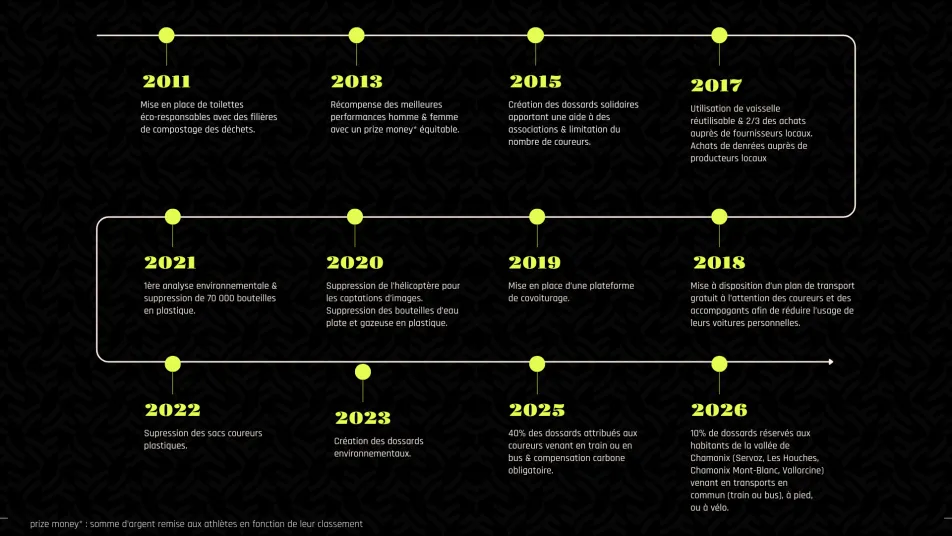
Discover below all the initiatives implemented to reduce the environmental impact of the Mont-Blanc Marathon, raise awareness about preserving our valley, and promote an innovative and sustainable model for sporting events that respects the Chamonix Valley and its residents.



Transportation:
our biggest challenge in reducing the event's carbon footprint
📝Environmental impact assessment 2023 = initial findings
The environmental impact assessment carried out in 2023 showed that 96% of the carbon impact of the Mont Blanc Marathon was linked to the transport used by runners and their companions to get to Chamonix. Every year, almost 10,000 runners come to Chamonix to experience the adventure of the Mont Blanc Marathon. To preserve this playground, we have redesigned the registration system.
🚅 Favoring the use of public transport
Since 2025 we've been encouraging runners to use eco-responsible public transport such as trains and buses, with 40% of race numbers reserved for these modes of transport.
👫 Facilitating registration for Chamonix Valley residents
In 2026, we're going even further with the introduction of a strong new measure dedicated to locals. 10% of race numbers will be reserved for residents of the Chamonix valley (Servoz, Les Houches, Chamonix-Mont-Blanc, Vallorcine) coming by public transport (train or bus), on foot or by bike. Indeed, the participation of Chamonix valley residents has virtually zero carbon impact when it comes to getting to the start of the races. What's more, it's important for us to make it easier for them to access this event, which takes place in their own backyard.
→ So, for the 2026 edition, 50% of race numbers are allocated without going through the draw, to runners coming by public transport to thus limit the environmental impact.
🤝Sustainable mobility solutions for all
In order to limit the environmental impact of the event and to facilitate travel during the Mont Blanc Marathon weekend, we are implementing several sustainable mobility solutions for runners and their companions.
Using public transport
Public transport timetables are communicated in advance to all runners, to facilitate their travel arrangements.
Those staying in the commune benefit from a guest card, giving them free access to trains and discounts on buses in the Chamonix Valley.
Special free transport
Since 2018, the organization has been financing buses and trains so that runners and their companions can access the race starts and refreshment points furthest from the center of Chamonix free of charge.
A dedicated car-sharing platform
Since 2020, we've been encouraging runners to discuss their travel arrangements and organize carpooling via the Togetzer carpooling platform.

⚖️Compensation carbon offset mandatory for all
Carbon offsetting, or rather carbon contribution (since not all emissions are offset, particularly those of accompanying persons), involves financing environmental projects aimed at storing, reducing or avoiding greenhouse gas (GHG) emissions. It thus offsets part of the emissions generated by the event and its participants. The carbon contribution is an additional action to enable everyone to participate, up to the level of their emissions, in this collective effort.
Participants
Since 2023, participants have been able to offset their travel on a voluntary basis. Since 2025, the payment of carbon offsetting linked to greenhouse gas emissions from participant transport has been made compulsory for all runners, regardless of the transport used to get to the event.
The organization
The organizing committee has also offset the carbon footprint of the event.
🌳Investing in concrete projects : Agroforestry
As an association, it was important for us to donate the funds raised to an organization in line with our values. The chosen organization was the Association Française d'Agroforesterie (AFA). This organization promotes the development of agroforestry: a practice that involves integrating trees into agricultural systems, with multiple environmental and climatic benefits. In addition to capturing atmospheric carbon, these systems promote crop diversification, soil preservation and farm resilience.
What actions are supported by the AFA?
For winter 2025-2026, seven agroforestry projects have been supported in Allier, Puy-de-Dôme, Loire, Drôme and Haute-Loire.
These initiatives aim to integrate trees into farming systems to promote biodiversity, improve soil quality, create shade for livestock and crops, and strengthen farm resilience. A positive, local and sustainable impact in line with our philosophy.
🚗Évolution des chiffres des transports
Figures for 2025 VS 2024
Thermal car: in 2024, 36% of participants travelled to the event by thermal car, compared with 16% in 2025.
→ Car use has therefore been halved.
Train/Bus: 48% of participants came by train or bus vs. 20% in 2024.
→ Train and bus use has therefore more than doubled.
And what about the plane?
The choice of mode of transport is a key factor in reducing the event's carbon footprint.
Indeed, the 76% of participants who used low-carbon transport accounted for 19% of the event's carbon footprint, while the 6% of participants who came by plane accounted for the majority (56%) of the event's carbon footprint.
→ Even if few in number, this travel weighs very heavily.
Find out more about the breakdown of emissions for the Mont Blanc Marathon 2025
Consult the document
🏋️♀️Le weight of the event
Following the impact analysis carried out by Aircoop, the event's carbon footprint was measured at 4369 t of CO2eq, or 452kg of Co2 per participant.
📈Evolution of the carbon offset amount
Since 2023, carbon offsetting had been offered to participants on a voluntary basis, raising €6,000 per edition, in 2025 carbon offsetting became compulsory, raising €55,000 at a cost of €60 per tonne of CO2 emitted.
Breakdown of the 4369t Co2eq:
4,137 t of CO2 eq are linked to the transport of participants and accompanying persons, of which 1,527 T of CO2 eq corresponding to the transport of participants have been offset .
= €55,000 collected from participants
The remaining 232 t of CO2 were also offset directly by the organization
= €15,000 paid back by the event to offset its carbon footprint.
→ A total of €70,000 was donated to the Association Française d'Agroforesterie (AFA) to offset part of the event's carbon footprint.

Reducing waste and preserving resources
Every refreshment station at the Mont Blanc Marathon is designed to limit the organization's environmental impact, while ensuring a quality experience for runners. For several years now, the event has been implementing concrete, innovative practices:
♻️ Zero plastic bottles
Since 2021, all plastic bottles have been eliminated from the refreshment stands, thanks to an in-house system for producing still and sparkling water.
In 2024, the organization is going even further: Coca-Cola bottles are also disappearing, in favor of Coca-Cola syrup to be mixed with the sparkling water.
So no more plastic bottles are used at the refreshment stands!
🍏 Local and organic products
Sausages, tommes, beers, fruit, bread or sandwiches: the products on offer are mostly sourced from local producers and craftsmen, located as close as possible to Chamonix (Fermes de Montroc et de Vallorcine for tommes, Salaisons du Mont-Blanc for sausages, boulangerie Richard for bread and sandwiches, Brasserie du Mont-Blanc for beer, Maulet Primeurs for fruit).
In Emosson (supplying the Swiss side), we also work with local producers: Ferme des Lisats, Duay & fils, and Boucherie Chanson.
🗑️ Waste sorting and recovery
In partnership with the SITOM and Ecotrivelothe event sets up a rigorous sorting system for recyclable and compostable waste. Compost buckets are set out in large numbers at each feed station, and volunteers are on hand to ensure that the rules are observed. Any runner seen deliberately littering the course will be penalized.
85% of the waste generated is organic and composted in Chamonix.
Important : the Mont-Blanc Marathon does not accept waste from accompanying persons (picnics, bottles, etc.). Accompanying persons are responsible for managing and disposing of their own waste.
🧭 Refreshment station access and assistance rules
- Only runners wearing a visible race number and duly checked have access to refreshment stations.
- Individual assistance is only permitted 100 meters before and 100 meters after the feed stations. Outside these zones, assistance is forbidden, as is support during the race.
🔁Priority to reuse/share
- Since 2017, the markings used on the courses have been designed and manufactured with a view to being reused every year.
- Ground markings are prohibited outside road sectors, and when they are necessary, they are made with biodegradable chalk-based bombs.
- Visuals in event colors are made from recyclable and recycled fabric.
🏁Bulk and local shopping.
Bulk purchases, optional runner's t-shirt
We also favor bulk purchases of minimally packaged products with recyclable packaging. We have also replaced the trophies formerly offered to runners in all categories with eco-responsible and/or consumable diplomas and gifts.
Trophies in line with our commitments (produced by a young Chamonix company)
Since 2024, the trophies offered to the winners (scratch classification only) of the various races have been manufactured by Pahapa, a young company made in Chamonix. They are produced from biosourced corn, recyclable and industrially compostable!
📱Event communication
- All the information needed by runners is sent by e-mail. In this way, we limit paper-based administrative procedures, via online registrations and the reduction of paper documents when handing over race numbers (digitalized system).
- Since 2015, all documents and appointments have been digitized, reducing the need for printouts.
- Partner POP advertising is made from recycled and recyclable materials and produced for a minimum of 3 years.
🏅Medals
New for 2026, the medals handed out at the finish of the races will be made by a Chamonix-based company from recycled wood sourced from local carpentry firms.

Preserving an exceptional territory
Before each race, the teams in charge of marking out the course also have the task of collecting any garbage that may be present on the course.
After each race, a team removes the markers and checks that no garbage has been unintentionally dropped by runners. Any littering by a runner is penalized by a time penalty.
🐐Presentation of the reserve
4 races organized as part of the Mont Blanc Marathon cross the Aiguilles Rouges Nature Reserve: the 90km, the 42km, the 23km and The Young Race.
Nature reserves are a tool for protecting natural environments. They protect areas, species, geological and/or biological heritage. Their main aim is to maintain or improve a state of conservation, but also to manage natural environments and raise awareness of their protection.
We make our runners aware of the need to protect the environment, applying zero tolerance to littering and requiring them to stay on the trails. We also encourage them to keep their eyes peeled for remarkable animals, flowers and plants along the trails, and to avoid disturbing the animals that call the reserve home (ibex, chamois, wild boar, eagles, etc.)!
We also adapt our routes and organization to the environments we cross: schedule changes if necessary, possible variations depending on weather conditions, corridor markers to avoid trampling sensitive areas, sections of the route closed to accompanying persons, increased volunteer presence in high-risk areas.
👍Good practices to adopt
- Stay on the trails
- Don't cut bends either on the way up or on the way down (this encourages erosion).
- Respect race markers and permanent markers.
- Do not use a drone
- Practice during the day, as disturbance is greater at night.
- Get into the habit of putting your garbage in a pocket where it cannot escape.
- When approaching a wild animal, slow down and let the animal move away at its own pace.
- Know how to behave in the presence of guard dogs
- Do not share your digital tracks, especially if they are false!

In addition to the money raised through carbon offsetting, we're going one step further by helping associations and/or NGOs working to preserve the environment in the Mont-Blanc region. To this end, we're donating €3,000 each to Sylv'acctes and CREA Mont-Blanc to help them in their missions.

🌱L'Association Sylv'ACCTES, Forests for tomorrow
This association was created to support virtuous forestry actions. As part of its mission contributing to the defense of the natural environment, its purpose is to contribute to, promote, coordinate, develop and finance actions aimed at:
- Promote the climate change mitigation effect of forestry.
- Sustainably preserve forest resources and ecosystem services.
- Protect and enhance the role of sustainable forest management in local socio-economic activity.
⛰️Le CREA Mont-Blanc (Centre de recherche sur les écosystème d'altitude)
This UN-recognized scientific NGO's mission is toexplore and understand the impact of climate change on biodiversity, and to share this knowledge to help decision-makers and citizens take better action.
An expert in alpine ecology and data science, CREA Mont-Blanc has put participatory science at the heart of its approach by involving researchers, decision-makers and the general public in its observatory of mountain biodiversity and climate change.
🏃♀️➡️Les environmental bibs
In 2026, 40 environmental bibs will be sold, divided between the Duo Etoilé, the 23km, the 42km and the 90km of Mont-Blanc. The funds raised by these donations will be used to finance the above-mentioned associations/NGOs, as well as to help finance dry toilets around Lac Blanc and in the Chéserys sector, a much-frequented area of the Aiguilles Rouges.

Raising awareness
the entire Mont Blanc Marathon community to environmental issues.
🙌Working together for an environmentally-friendly event
- Raise awareness and encourage service providers and partners to adhere to our environmental actions. Carbon offsetting has been offered to partners and exhibitors since 2026, and will become mandatory from 2027.
- Raise awareness among volunteers and teams through collaborative workshops such as the "climate fresco".
- Raise awareness among participants and the wider Mont-Blanc Marathon community on social networks: Instagram, Facebook, Strava, Tiktok about the environmental challenges of an international sporting event. And also on the website, in the newsletter and during the live event (digital and TV). Promote an innovative and sustainable model for sports and tourism, based on respect for the Chamonix valley and its people.
- Offer environmental roundtables to runners and their companions during the event.
- Involve public figures, ambassadors and environmental associations such as POW (protect our Winters) to raise public awareness of the various issues and best practices.